Thursday, 26 December 2013

Newman's Jewellers

Alstons Corner Building (1913), Collins and Elizabeth Street, Melbourne


I found another painted sign while walking around the city. When I took the photo I was unsure of the actual date, but the colour pallet and fading of the paint as well as the typesetting of the sign to me indicated it had some age to it. With a little bit of research I uncovered part of the story of the Newman's Jewellers sign.


Hand painted Newman's Jewellers sign, side of Alstons Corner


If you look really closely you can see there are two layers to the Newman's Jewellers sign. The link to this black and white photo shows you the original sign, which proudly reads Newman's Jewellers. Unfortunately I could not find a date for this photo but I assume it was taken not long after the sign was painted. If you look closely at the photo I took you can see the original type in red paint, and then a second layer on top which is indicating that they have relocated. Something like this is so easily missed or forgotten about, which in many ways is sad as Newman's Jewellers was a significant business during it's time.

Newman's Jewellers was founded in 1852. To put this into a historical perspective, this is one year after the beginning of the Victorian Gold Rush. It highlights how the city of Melbourne was built on the proceeds of gold, and that people flocked to the city to set up businesses and take advantage of this new found wealth. Obviously Newman's Jewellers was a solid business and was well regarded and trusted in the community as it was around for a long time. They moved from their location at Elizabeth street, where the sign is, to a location in Collins Street some time in 1930.

If you are interested here is a link to a digitised newspaper article from the 27th of June 1931, which makes reference to the Newman's business and explains it's standing and important place as a jewellery company in Melbourne.

It would be curious to see if any academic research has been done on this sign. Conservation research could uncover interesting things like the type of paint that was used and how many times it was repainted. But isn't it incredible that something of this age which has been exposed to the elements and left unprotected is still with us today?!?!

Love
Mosey x


Tuesday, 26 November 2013

A Whimsical Adventure

I feel this whimsical street art composition is appropriate to post on such a lovely sunny Melbourne day.

Found by surprise down Melbourne Place, Melbourne, I couldn't leave without taking a photo of it.

Anyone fancy taking a flying and sailing adventure???


Love
Mosey x


Church Street Hawthorn

Along Church Street, Hawthorn there is a great strip of shops and cafes that I really enjoy visiting. There is some really beautiful and interesting architecture here as well. I love seeing the eclectic mix of architectural styles and eras which is often seen in these types of local shopping strips. If you take a walk around the side streets as well you will see some incredible homes. It's such a picturesque area.

Here are some photos of my favourite buildings along here.

Love
Mosey x


Sunday, 20 October 2013

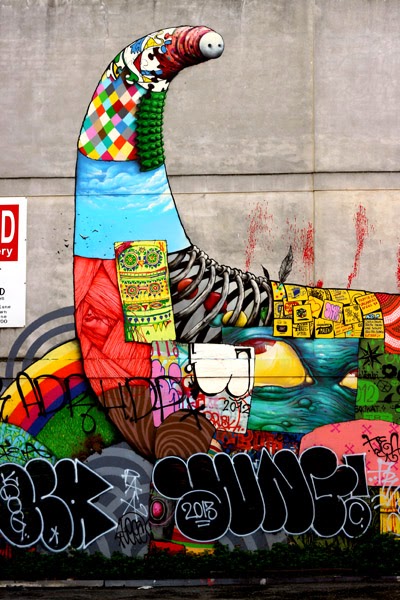
A monster in China Town

This is a great street art composition I found down China Town. I love the vibrant colours and the use of pattern. To me it looks like a patchwork quilted monster, in the way they have divided up sections of the body with different patterns and colours. It's a bit of a pity that people have tagged over the top of it, but that's the nature of street art.

Love
Mosey x


Friday, 18 October 2013

Progress

The subject of 'progress' is an interesting topic, with everyone having their own opinion.

While studying my degree in archaeology we were frequently presented with the ideas of progress, preservation and conservation, and the precarious balance between these issues. 

In archaeology we are taught the harsh truth that in its nature archaeology is destruction. In order to learn and discover we must pull apart and destroy the site. This of course means that a strict code of ethics must be applied to all archaeological research, which also includes consideration for preservation and/or conservation measures. Here in Melbourne, Heritage Victoria and the National Trust have a say in the outcome of archaeological sights and historically important buildings. But as to be expected there are always many interest groups involved. 

These kinds of ethical and moral questions can be applied to older architecture, and the way in which it affects our changing urban landscape.

It is impossible and unrealistic to keep all our beautiful old buildings. If we were to try, it would hinder progress and new developments in design, building techniques and technology. As time passes our wants and needs, as well as the way we use and relate to spaces changes. Older buildings aren't always practical or usable in their original intent or purpose. Does that in a moral sense make it ok to change the building or to even demolish it? What types of buildings are worthy of keeping in tact? Who decides upon the criteria in which these buildings are subject to?

These types of questions may seem slightly absurd or petty when thinking of an unused 1940s office building, or the run down Federation style home in the street next to yours. However they are important things to consider in a holistic sense. If no one is considering these things, and we all rush out and knock down every old home or change every heritage building to the point where they are no longer recognisable, we will lose all our history and the opportunity to discover and learn about our past. 

I'm not saying we need to go to the extremes of opposing every new development, but just some thought, consideration and care needs to be applied. The two most important questions to ask are, how will this change our urban landscape, and is what will be replacing the original building or structure worthy to be put in its place?

It is these questions of progress, preservation and conservation that I ask myself when I see an old building, particularly when new development is proposed or has begun. Perhaps these are some things you can ponder as you look at the photos on this blog and when you see progress happening in your own local area.

Love
Mosey x


There was much controversy with this Collins Street site in the 1970s, as several historical buildings were demolished to make way for the Nauru House and to give it a Collins Street frontage and address. There is still mixed feelings about the way in which the space in front of the Nauru House has been used, many feeling it is an unattractive use of the space and not worthy of replacing the original buildings.

Right side details showing 'scaring' effect on the brick work as a result of the demolished building.

Details showing the resulting effects on the brickwork on the standing building. If you look closely you can see the outline of the demolished building.

Construction site on the corner of Lonsdale and Russell Streets. You can see modern additions to the older building on the left of the construction site.

Collins Street, Melbourne. You can see construction of a new building happening behind these two strong, solid historical buildings. It will be interesting to see how the skyline will change once construction has finished.
Taken from the Myer Emporium building, of the old Myer building on Lonsdale Street. This building was sold in 2009, and in its original form obviously didn't suit the needs of the new owners. This is a great example of a popular solution for some historical buildings. The facade is kept intact, however what is done with the interior is up to the owners. This photo highlights both the original front and back facade. 

Back view of the front facade of the old Lonsdale Street Myer building. You can see the way the facade is being held up while each interior levels are built up. 


Tuesday, 1 October 2013

Street Art

Street art is something I have not explored on my blog yet, and may seem a bit left of centre compared to my previous posts. However it is one of those things that you stumble across when you are out and about, which is the overarching theme of this blog.

As a snapshot in time, street art will probably become an important indicator and/or way to trace social history in the future; not only through artistic styles, but through the themes and subject matter and how that relates to the issues of our time.

These pictures were taken down Croft Alley, which is off Little Bourke Street in China Town. Very much hidden away, it was exciting to see so many different styles, compositions and colours together in this space.

Love 
Mosey x


Sunday, 29 September 2013

Painted Signs

Here are two pictures of painted signs I came across when I was wandering around the city. 

The first painted sign is on the corner of Lonsdale and Russell Street. I had seen it a few weeks ago but I didn't have my camera with me. When I went back construction on the site had begun, and the scaffolding was obstructing the view of the sign. However I still think it was worthy of recording.

The second painted sign is down Bourke Street. The blue and yellow is still rich in colour, making the sign stand out against the side of the inter-war period building.


Love 
Mosey x


Sign on the corner of Lonsdale and Russell Street


Sign located down Bourke Street